



Chasing Pelicans, Capturing the Wild with Cover Artist Dustin LeBlanc

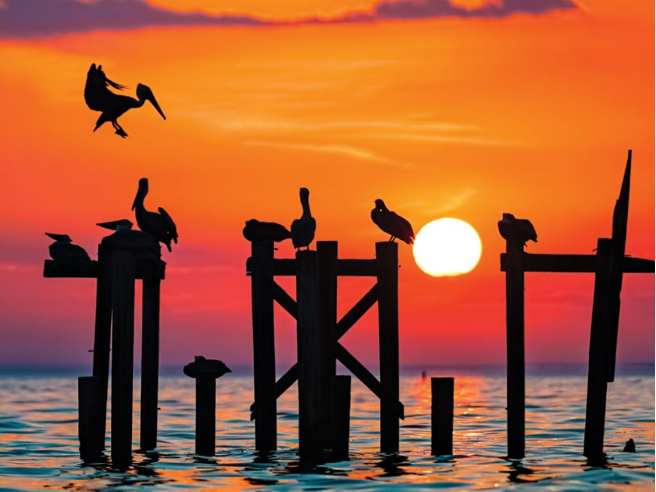

DUSTIN LEBLANC PHOTOGRAPHS the sunrise every day.
Before the sun wakes up, Dustin is already in his duck waders and waterproof camo, with his fixed prime lens camera in hand. Tiptoeing past his wife and four sleeping children—Bella, Dre’, Duke, and Lily-Ann—, he heads out the door ready to drive to what he has dubbed Pelicans’ Row.
At the end of Lakeshore Drive in Mandeville, when it’s that perfect time of year, all the brown pelicans line up along a dead pier. He slips into the water before the pelicans ever start flying and landing, working his way closer and closer. As he inches his way towards them, he silently captures multiple rounds of pictures, measuring every moment and taking advantage of every angle before the vibrant, balanced colors of the sunrise disappear.
Without a tripod or any solid surface, Dustin depends completely on himself and nature. His camera selection is calculated: the fixed prime lens allows him to get the exact dimensions that he wants, aiding him in darker settings—much more reliably and accurately than the telephoto lenses, which might only allow a photographer to capture the bird and a brief bit of the setting in the background. This is in opposition to the level of intimacy provided by the fixed prime and the prime directive of the man behind the lens.
“When you use the fixed prime and get close, you really get your people embraced into the scene.”
And that’s what he wants: to put his people in the middle of nature, right where the bird lands, and right where the oak tree grows. One of his greatest inspirations has always been the old oak trees of New Orleans. His work captures their grandiosity and wisdom.
“The main oak I want to feature is the Seven Sisters, named for the seven Doby sisters whose property ran along the lake. It’s only two blocks from my house in historic Lewisburg, Mandeville,” he says. “She is the President of the National Live Oak Society and is estimated to be 1,250 to 1,500 years old.”
Personifying oak trees is only half of how Dustin proclaims his love for Mother Nature. As a devoted father of four–with boys and girls from nine to nineteen years of age–and an adventurous husband, Dustin is passing on his love of trees, the sky, and the swamp to his family, taking them along for the ride.
Dustin and his wife enjoy kayaking together; he steers, and she snaps candid photos of alligators, ospreys, and bald eagles. His sons and daughters tag along with him to fish, bike, camp, and go boating together, excavating for what they have branded “brackish booty,” their own pirates’ haul of barnacled and sea-worn items they find and repurpose into treasure.
Growing up on the Southshore, Dustin always wanted to be a photographer, but instead he became a resident DJ in the Marigny and French Quarter at just 18 years old. Music was, and continues to be, another artistic expression of himself that Dustin does with complete authenticity.
As he was hired for more and more gigs, he brought with him his secret vision to photograph himself DJing. He hired a young photographer, and together they created a series of photographs of Dustin with the music legends of the 90s like Juvenile, Snoop Dogg, Afroman, and Partners in Crime. Dustin just didn’t have enough time to be behind the lens.
When the gigs started to slow down, his body clock did not. Because his normal routine was to be out till the wee hours before dawn, he naturally started waking up around 3 am, which he quickly realized, as the outdoorsman in him said, was the perfect time to capture the quiet of nature before the world woke up.
While Dustin’s favorite location to photograph is the Northshore, he does try to capture nearly every pocket of New Orleans, from the New Canal Lighthouse and Bonnabel Boat Launch to Sail 250 and the streets of the French Quarter, where he walks with his camera, capturing candid moments of people and places. But the Northshore remains his favorite place to photograph, particularly its magnificent oak trees.
Another tree has taken him much farther afield. Dustin has become fascinated with the Cat Island Cypress, believed to be the largest and oldest living cypress tree. His interest in cypress trees is personal, too.
“We don’t have them here on the Northshore anymore,” he explains.
He has learned about the area’s history and the great cypress forests that once surrounded Mandeville. Before the first-growth cypress trees were harvested for replanting and landscaping elsewhere in New Orleans, explorer Jean Lafitte reportedly described the area as the most beautiful site he had ever seen.
The trees may no longer line Lakeshore Drive from Lewisburg to Lacombe, but their story has stayed with Dustin and strengthened his desire to capture and preserve what remains.
That appreciation for nature can be seen throughout his work. Dustin has a particular love for reflections, especially after a storm.
“I love reflection. Give me rain, give me puddles, I’m in heaven,” he says.
His Jumping in Puddles series, photographed in Fontainebleau State Park, captures that fascination. At the lakefront, water can transform the landscape, reflecting the massive oaks and Spanish moss in a way that makes the scene feel almost surreal.
Getting the perfect image, however, is anything but accidental.
“When I take a picture, the intention is not to crop it,” Dustin explains.
He may take seven photographs of the same scene to get the horizon exactly where he wants it. At the same time, he may be wading through the water as the sun shifts and pelicans move through the frame. He is watching everything, trying to place a pelican in the lower third and the sun in the upper right.

“A lot goes into it,” he says. “While it’s art, it’s also mathematical, just as music is.”
Dustin uses the rule of thirds and carefully considers balance, proportion, and perspective. His lens allows him to narrow the viewer’s focus to exactly what he wants them to see. Every photograph, he says, has a balance.
Most importantly, every photograph needs a subject. He might photograph a pier stretching over the beach, creating a path that draws the viewer into the scene. Or he might put on his waders, get down at sea level, and position his camera just above the waves, bringing people into the same space as the pelicans.
“I try to be different and make you say, ‘You put me there.’”
That philosophy is also why Dustin does not accept commissioned work. He wants the freedom to follow his own eye, whether that means chasing a reflection after a rainstorm, wandering through the French Quarter, or waiting for the right moment beneath an ancient oak.
His photography is not cropped or manipulated by AI. What you see is the moment as he found it, carefully composed in camera.
After picking up a camera, Dustin quickly found an audience that connected with his unique perspective. His work can primarily be found on Facebook and Instagram, where followers can also keep up with his pop-up galleries. One place you’ll be able to see his art for years to come is an original mural he created for Bank of America’s new location in Covington.
For Dustin, the goal has never been to become successful. It is to keep seeing, keep creating, and keep doing what he loves.
“If it takes me longer to be successful, that’s OK,” he says. “Happiness and doing what I love to do above and beyond is more important, which is why I do the things that I do.”
Follow Dustin and his photography on instagram @creoleshots